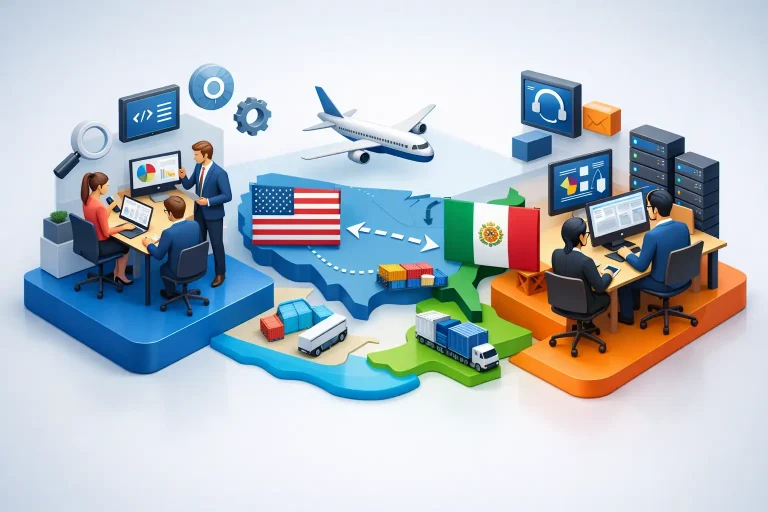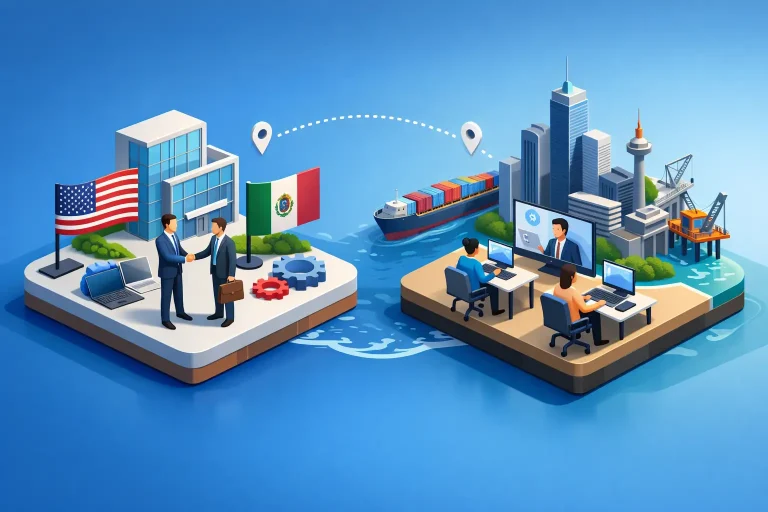
A controller opening sits unfilled for 90 days, month-end close keeps slipping, and your senior finance staff are buried in cleanup instead of analysis. That is usually the moment nearshore accounting teams move from a nice idea to a serious operating decision.
For US companies trying to grow without inflating payroll, accounting is one of the clearest functions to nearshore well. The work is process-driven, deadline-sensitive, and heavily tied to communication and accuracy. If you can add qualified talent in your time zone, lower hiring friction, and keep direct oversight, you do not just reduce cost. You improve execution.
What nearshore accounting teams actually solve
Most companies do not look at nearshoring because they want a different geography. They look at it because the domestic hiring model is slowing down the finance function.
Maybe accounts payable is backed up. Maybe reconciliations are lagging. Maybe your in-house team is spending too much time on transaction-heavy work and not enough on reporting, controls, forecasting, or exception management. In some businesses, the issue is scale. In others, it is turnover, cost pressure, or the simple fact that good accounting talent is hard to hire quickly.
Nearshore accounting teams address those problems by giving you access to dedicated professionals who can support day-to-day finance operations while working in sync with your US team. That time-zone alignment matters more than many companies expect. It shortens feedback loops, improves handoffs, and makes training, approvals, and issue resolution far easier than with teams operating half a day behind.
This model also works because accounting requires consistency. Once processes are documented, ownership is defined, and controls are clear, many finance tasks can be executed at a high level by an external dedicated team that feels like an extension of the business rather than a disconnected vendor.
Where nearshore accounting teams create the most value
The strongest use case is not replacing finance leadership. It is expanding capacity around it.
For many companies, the best results come from assigning structured, repeatable work to nearshore accounting teams while keeping strategic decision-making with internal leaders. That can include accounts payable, accounts receivable, billing support, bank and balance sheet reconciliations, journal entry preparation, expense review, reporting support, collections coordination, payroll support, and month-end close assistance.
In more specialized environments, nearshore talent can also support audit preparation, compliance workflows, transaction processing, and industry-specific back-office tasks. The exact scope depends on your systems, control environment, and how much process maturity already exists.
The business benefit is straightforward. Your higher-cost domestic staff spend less time chasing invoices, correcting input errors, or working through repetitive close tasks. They spend more time reviewing numbers, managing cash, improving controls, and supporting leadership.
That shift alone can make the finance team materially more useful to the business.
Cost matters, but it is not the whole case
Yes, labor savings are part of the appeal. For many US businesses, nearshore hiring creates meaningful cost efficiency compared with hiring equivalent talent domestically. But focusing only on wage arbitrage misses the stronger case.
The bigger win is cost-adjusted productivity.
If your accounting team is understaffed, delayed, or overloaded, you are already paying for the gap. You pay through slow closes, missed follow-up, weak reporting cadence, overworked managers, and leadership decisions made with incomplete data. You also pay when strong employees leave because they are stuck doing volume work below their level.
Nearshore accounting teams can reduce direct labor cost, but they can also help you close faster, improve responsiveness, and create room for better financial management. For growth-stage companies, that operational lift often matters just as much as the budget savings.
Why location and time zone make a real difference
Not all remote accounting support models are equal. Geography affects collaboration.
When your accounting team works during the same business day, communication gets easier. Questions are answered in real time. Managers can review work live. Training does not require someone to stay online at night. Urgent requests during close week do not sit in a queue until the next morning.
That is one reason nearshore accounting teams are often easier to integrate than far-off offshore models. They support day-to-day coordination without forcing your internal team to redesign its schedule around distance.
For companies that need bilingual support, cross-functional collaboration, or regular interaction with US-based finance leadership, that alignment becomes even more valuable. It helps the team feel operationally close, not just contractually attached.
How to know if your company is ready
Nearshoring works best when leadership wants scale with control, not scale with chaos.
If your accounting processes live entirely inside one manager’s head, a nearshore model will expose that quickly. The same is true if approvals are inconsistent, systems are fragmented, or expectations are undocumented. A nearshore team can absolutely help improve structure over time, but some baseline clarity is needed first.
You are likely a good fit if you have stable workflows, defined roles, and clear performance expectations. You do not need perfect documentation, but you do need enough process discipline to train effectively and measure output.
Readiness also depends on mindset. Companies that get the most from nearshore accounting teams treat them as part of the operating model. They invest in onboarding, set service-level expectations, and build reporting rhythms. Companies that treat nearshore staff as invisible back-office labor tend to get weaker results.
What to watch for before you build nearshore accounting teams
There are trade-offs, and serious buyers should look at them directly.
First, accounting is a trust function. Accuracy, confidentiality, and process compliance matter. That means your staffing partner should understand secure work environments, hiring standards, and operational oversight. Cheap talent without structure can create more cleanup than savings.
Second, not every accounting task should move immediately. Judgment-heavy work, highly sensitive approvals, and functions tied closely to executive decision-making may need to stay internal or transition slowly. A phased rollout is often the smarter move.
Third, systems access and training matter more than many leaders assume. If your team is switching between disconnected tools, lacks standard operating procedures, or gives inconsistent feedback, performance will suffer regardless of location.
Nearshoring is not a shortcut around management. It is a way to extend a well-run operation.
A practical model for building nearshore accounting teams
The most effective rollout usually starts with one pain point, not a full departmental redesign.
A company might begin with accounts payable and reconciliations, then expand into close support and reporting assistance once quality is proven. Another might start by adding one staff accountant and one AR specialist to relieve domestic bottlenecks. The right path depends on workload, internal management capacity, and the complexity of your finance environment.
What matters is role clarity. Each person should have defined responsibilities, measurable output, and a clear reporting line. Daily communication should be simple and direct. Weekly reviews should focus on accuracy, turnaround time, backlog, and exceptions.
This is where a nearshoring partner can change the outcome. The best partners do more than source resumes. They help structure the team, support hiring speed, provide operational infrastructure, and reduce the risk that comes with building in a new market. For companies looking at Guadalajara in particular, GDL Connect is built around that model – giving US businesses access to qualified talent, faster deployment, and the oversight needed to scale responsibly.
Nearshore accounting teams and long-term finance performance
The smartest finance leaders do not ask whether nearshoring is cheaper. They ask whether it makes the department stronger six and twelve months from now.
If the answer is yes, it is usually because the model improves more than headcount economics. It gives the business more capacity without overextending fixed costs. It reduces pressure on key managers. It creates a better operating rhythm around close, reporting, and transaction processing. And it gives leadership a way to grow without waiting on a difficult domestic hiring cycle every time volume increases.
That does not mean every company should move fast. It depends on your systems, your controls, and how ready your team is to manage distributed talent well. But for many US businesses, nearshore accounting teams are no longer an alternative staffing model. They are a more practical way to build finance capacity.
If your accounting function is holding growth back, the right next step is not always another expensive local hire. Sometimes it is building a team that gives you speed, control, and room to scale at the same time.