

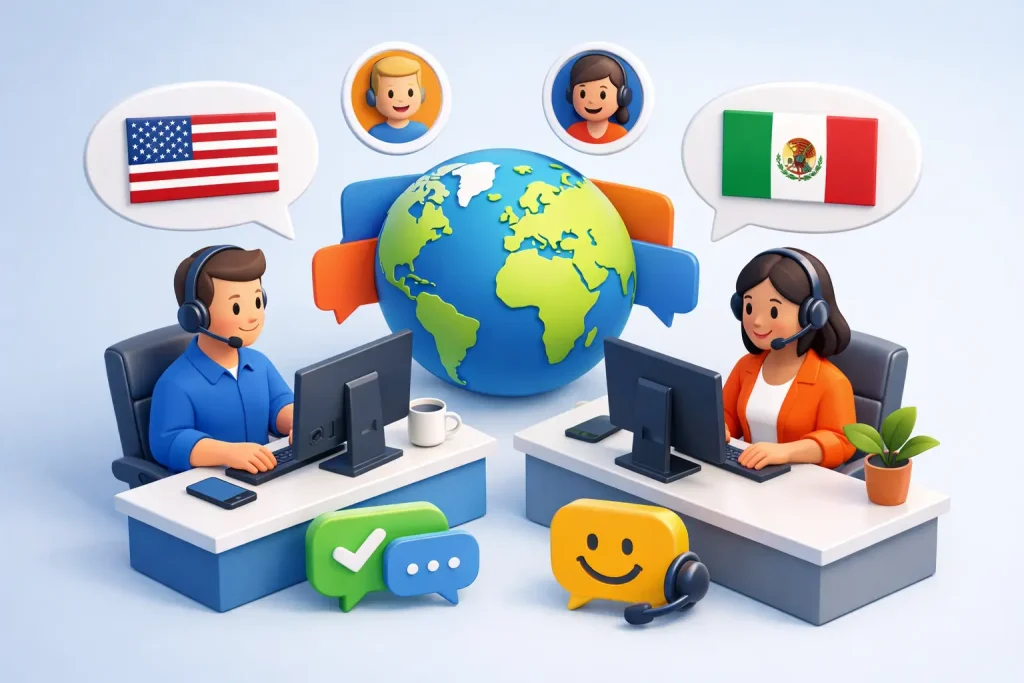
A customer calls with a billing issue, starts in English, switches to Spanish when frustrated, and expects the conversation to keep moving. If your team stalls at that moment, the problem is no longer just language. It is speed, trust, retention, and revenue. That is why bilingual customer support teams have become a practical growth lever for US companies that serve diverse customer bases and cannot afford friction at the point of service.
For many operators, the question is not whether bilingual support matters. It is whether building that capability in-house is worth the cost and time. In many cases, it is not. Domestic hiring can be slow, expensive, and inconsistent, especially when you need bilingual talent that can handle more than basic script reading. The better path often comes down to building a dedicated team in a nearshore market where language skills, time zone alignment, and operational oversight can work together.
What bilingual customer support teams actually solve
Most companies first think about language coverage. That is part of it, but it is not the whole value. Bilingual customer support teams reduce avoidable escalations, shorten handle times, and improve first-contact resolution because customers can explain the issue clearly the first time.
That matters even more in industries where details carry risk. In healthcare support, benefits, eligibility, and scheduling mistakes create downstream issues fast. In financial services, misunderstandings around documentation or payment status can damage trust. In real estate and mortgage workflows, speed and clarity affect conversion and borrower experience. Language support is not a nice extra in those settings. It supports accuracy.
There is also a staffing reality many executives underestimate. Bilingual support is difficult to scale reactively. If demand spikes during open enrollment, peak sales periods, or a product launch, companies that rely on a few key bilingual reps usually hit a bottleneck. A dedicated team model gives you more control over capacity planning instead of hoping one hiring cycle solves a structural gap.
Where bilingual customer support teams create measurable value
The business case usually shows up in four places.
The first is customer satisfaction. People are more patient when they feel understood, and less likely to churn after a service problem when the resolution is fast and clear. CSAT and NPS tend to improve when customers do not need to repeat themselves or wait for a transfer.
The second is conversion protection. Support is often tied directly to sales, renewals, and collections. If a customer cannot get a clear answer about onboarding, policy terms, payment options, or account status, that delay can become lost revenue.
The third is efficiency. Bilingual teams reduce translation workarounds, internal handoffs, and supervisor escalations. That lowers cost per interaction and helps frontline managers run cleaner operations.
The fourth is coverage. Many businesses do not need a huge contact center. They need a reliable extension of their operation that can cover voice, chat, email, and back-office follow-up without creating a management headache.
The hiring trade-off most companies run into
Hiring bilingual agents in the US can work well for some organizations, especially if the support function is tightly tied to a local market or requires niche licensing. But for many growth-stage and mid-market companies, the economics get harder fast.
You are competing for talent in a constrained labor market. Wage pressure stays high. Attrition can be expensive. And if you need support across multiple shifts or channels, the fully loaded cost grows beyond salary alone. Training, QA, workstation setup, and management overhead all add up.
This is where nearshoring becomes a practical operating decision rather than a cost-cutting experiment. A market like Guadalajara gives companies access to bilingual talent in the same or similar time zones as US teams, which helps with live collaboration, real-time coaching, and daily accountability. The lower labor cost matters, but the operating model matters just as much.
Why nearshore bilingual customer support teams make sense
The strongest nearshore setups do more than fill seats. They give you a dedicated team structure, stable oversight, and a faster path to production.
Time zone alignment is one of the biggest advantages. When your support leads, QA managers, and trainers can work in parallel with the team, issues get resolved faster. Schedule changes are easier. Escalations do not sit overnight waiting for answers. That is a meaningful difference from offshore models that create a longer feedback loop.
Proximity also improves control. Leaders can visit teams, run in-person training when needed, and stay closer to the operation without the complexity of managing a distant vendor relationship. For companies in regulated or customer-sensitive industries, that visibility matters.
Then there is talent depth. In established nearshore markets, bilingual capability is not rare. The better candidates often have customer service experience, familiarity with US business standards, and stronger communication skills across voice and written channels. That shortens ramp time if your onboarding process is structured correctly.
GDL Connect is built around that operating reality, helping US companies stand up dedicated teams in Guadalajara that combine bilingual capability, speed to hire, and tighter day-to-day control.
What to look for before you build the team
Not every bilingual hire is a strong support hire. Fluency is only the baseline. The real question is whether the team can perform under your service model.
Start with channel fit. Voice support requires confidence, pace, and listening discipline. Chat and email require grammar, clarity, and brand consistency. Some agents are strong in one area and average in another, so hiring against actual channel demand matters.
Next, look at issue complexity. A team handling appointment setting or order status will need a different profile than one handling claims support, mortgage updates, or software troubleshooting. The more regulated or technical the workflow, the more important process discipline becomes.
Quality assurance should be part of the design from the beginning. Bilingual teams need scorecards that measure more than friendliness and script adherence. You want to review comprehension, accuracy, policy handling, documentation quality, and whether the agent can move naturally between languages without losing control of the interaction.
Training also deserves more attention than many companies give it. If your English-language support already has knowledge gaps, those gaps will not disappear just because a team is bilingual. Good onboarding should cover systems, escalation paths, compliance expectations, and brand tone in both practical and measurable terms.
Common mistakes that weaken results
One common mistake is treating bilingual support as overflow labor. If the team only gets the hardest calls, the least documentation, and the weakest processes, performance will suffer no matter how good the talent is.
Another is over-prioritizing cost and under-prioritizing management structure. A lower hourly rate will not fix weak forecasting, poor training, or lack of QA. The right partner should help you build an operating model, not just provide headcount.
There is also a tendency to assume all Spanish-language demand is the same. It is not. Customer expectations differ by channel, region, and industry. Scripted service may be enough for basic transactions, but sensitive interactions often require agents who can adapt tone and explanation style without sounding mechanical.
Finally, companies sometimes wait too long to add bilingual capacity. By the time complaints rise or abandonment worsens, the issue is already affecting retention and brand perception. Building earlier usually costs less than fixing service damage later.
How to know the model is working
The best indicators are not complicated, but they need to be tracked consistently. Watch first-contact resolution, average handle time, QA scores, abandonment, CSAT, and the percentage of interactions resolved without translation support or internal transfers.
Also look at operational signals. Is training time improving? Are supervisors spending less time on preventable escalations? Is the team absorbing new workflows without a drop in quality? Those are signs you are building a stable function, not just patching coverage gaps.
If revenue is tied to support, measure that too. Renewals, collections recovery, intake conversion, and appointment show rates often improve when customers can communicate comfortably and get answers fast.
The real advantage is not just language
Companies that get the best results from bilingual customer support teams do not think of them as a courtesy feature. They treat them as part of a smarter staffing strategy – one that improves service levels, protects revenue, and gives leadership more flexibility as demand changes.
That is especially true for businesses trying to scale without adding unnecessary fixed cost. A dedicated nearshore team can give you language coverage, stronger customer experience, and operational breathing room at the same time. The value is not just that customers can speak in the language they prefer. It is that your business can respond with speed, consistency, and control when it counts most.
If customer experience affects retention, compliance, or conversion in your business, bilingual support is not a future-state idea. It is a hiring decision with direct operational upside.