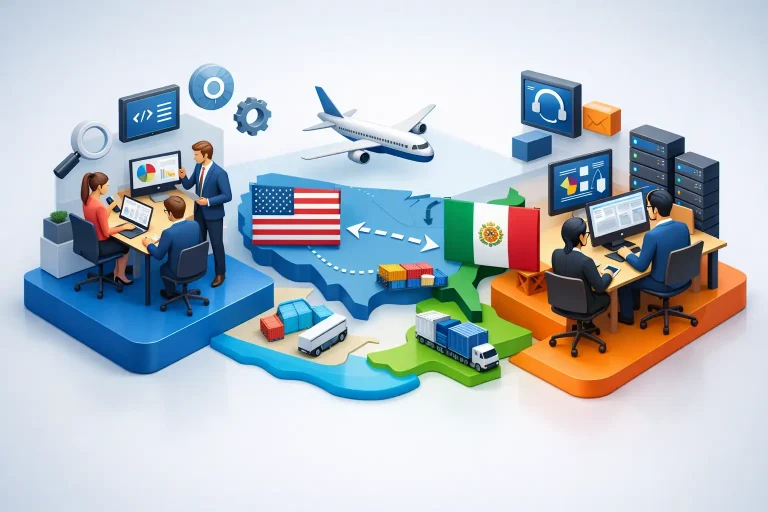
When a role stays open for 60 or 90 days, the real cost is rarely just recruiting spend. It shows up in missed revenue, slower service, overworked managers, and teams that cannot keep pace with demand. That is why more US companies are looking at Guadalajara staffing services as a growth decision, not just a labor arbitrage play.
For the right business, Guadalajara offers a practical way to add capacity fast without giving up visibility or quality. You can build support, technical, financial, and customer-facing teams in the same general working hours as the US, with strong bilingual talent and far lower employment costs than many domestic markets. The appeal is clear. What matters is understanding why this market works and where it fits best.
Why Guadalajara staffing services stand out
Guadalajara has become one of the strongest talent markets in Mexico for companies that need more than entry-level support. The city has deep professional talent across operations, software development, finance, customer service, marketing, and compliance-related functions. For US companies under pressure to scale quickly, that range matters.
Cost is part of the story, but it is not the whole story. A lower-cost market only helps if the talent can perform, communicate clearly, and integrate into your workflows. Guadalajara checks those boxes better than many offshore alternatives because it combines a mature professional labor pool with geographic proximity and business-hour overlap.
That time-zone alignment changes how work gets done. A customer support issue can be handled during the same day. An accounting question does not need to wait overnight. An engineering team can collaborate in real time instead of stretching communication across a full-day lag. For operations leaders, that often means fewer delays, faster decisions, and tighter execution.
There is also a cultural and commercial advantage. Teams in Guadalajara are often well positioned to support US-facing business processes, especially when bilingual communication and client responsiveness matter. In industries where precision and service quality affect retention, that is not a small benefit.
The business case goes beyond lower payroll
Companies usually start the search for nearshore talent because domestic hiring has become too slow, too expensive, or both. But the strongest case for Guadalajara staffing services is broader than savings alone.
The first gain is speed. Hiring in tight US labor markets can drag out for months, especially in operations-heavy or specialized support roles. A strong staffing partner can reduce that timeline substantially by sourcing, screening, and onboarding talent in a market built for this kind of cross-border support.
The second gain is focus. When leadership teams spend too much time backfilling routine but essential work, higher-value initiatives stall. Moving process-driven tasks, support functions, or repeatable technical work to a dedicated team in Guadalajara gives your US leaders room to work on growth, client relationships, and strategic execution.
The third gain is control. This is where nearshoring often beats traditional outsourcing. If your model is built around dedicated staff integrated into your systems, metrics, and management structure, you keep a much tighter grip on quality. You are not handing work off and hoping for the best. You are building an extension of your team.
That distinction matters in finance, healthcare support, mortgage operations, and other detail-sensitive functions. Businesses in these sectors need capacity, but they also need consistency, oversight, and compliance discipline.
Which roles are a strong fit
Not every role should move to a nearshore team, and that is where smart decision-making matters. Guadalajara staffing services are most effective when the work is repeatable enough to document, valuable enough to justify dedicated headcount, and collaborative enough to benefit from shared business hours.
Operations support is often a clear win. Teams handling data entry, reporting, transaction coordination, scheduling, quality checks, and back-office processing can create immediate relief for overloaded departments. These functions are essential, but they do not always need to sit in a high-cost US market.
Customer-facing roles can also perform well, especially when bilingual support is useful. Sales support, customer service, account coordination, and post-closing assistance are all stronger when communication is timely and natural. Real-time collaboration reduces handoff friction and improves the customer experience.
Technical hiring is another major use case. Guadalajara has a well-developed talent base for software engineering, QA, IT support, and increasingly AI-related roles. For US companies struggling to hire technical talent at sustainable rates, this creates room to scale product and support functions more efficiently.
Financial and compliance-related roles can also work well, but the model needs more structure. Accounting support, reconciliations, document review, compliance administration, and other controlled workflows tend to succeed when process ownership is clear and training is strong. The trade-off is that these roles often require more deliberate onboarding than general administrative support.
What decision-makers should look for in a staffing partner
A staffing provider should do more than send resumes. If your goal is operational scale, the partner needs to help you build a team that can perform inside your business, not just technically qualify for a job description.
That starts with talent quality and screening discipline. You want a partner that understands the role beyond the title, including communication standards, workflow expectations, and the business outcomes the hire is meant to support. A sales support specialist for a fast-moving real estate business is not the same as one supporting a complex healthcare workflow.
Infrastructure matters too. Cyber-secure offices, reliable equipment, stable connectivity, and managed work environments are not extras for serious companies. They are part of risk control. If your team handles client data, financial records, or sensitive operational workflows, the staffing model has to support that reality.
Compliance is another area where executives should pay close attention. The right partner helps reduce legal and administrative complexity while giving you confidence that staffing is being handled in a way that aligns with US business expectations. That does not mean every risk disappears. It means the model is built with professional guardrails.
Finally, look at oversight. Can you manage performance clearly? Can the team be ramped up in phases? Is the provider set up to support retention and continuity, or are they simply focused on placement volume? The answers shape whether nearshoring becomes a stable growth lever or just another hiring experiment.
Why Guadalajara works especially well for scaling companies
Fast-growing businesses often hit the same wall. Revenue is moving, demand is rising, and the core team is stretched thin. Hiring domestically for every role starts to pressure margins, but letting service levels slip is not an option.
This is where Guadalajara becomes strategically useful. It allows companies to add skilled headcount without building an expensive cost structure that limits future flexibility. You can staff for today’s workload while preserving room to invest in sales, product, or expansion.
That is especially valuable in industries with uneven hiring pressure. Mortgage, real estate, healthcare administration, insurance, finance, and marketing operations can all experience spikes in volume that do not justify slow, high-cost hiring cycles. A nearshore staffing model gives leaders a more agile way to respond.
It also supports better organizational design. Instead of forcing senior US employees to absorb process-heavy work, companies can build layered teams with clearer ownership. Senior staff stay focused on judgment-intensive tasks. Nearshore team members handle execution, support, and workflow continuity. That structure tends to scale better.
The trade-offs to consider
Guadalajara staffing services are not a shortcut around management. They work best when the company is ready to onboard well, define roles clearly, and manage outcomes consistently. If processes are messy or leadership expects a new team to solve structural issues on its own, results will be uneven.
There is also a learning curve. Even with strong bilingual talent and time-zone alignment, teams need process documentation, training, and performance expectations. Companies that treat nearshore staffing as a plug-and-play fix usually leave value on the table.
The better approach is to start with the right roles, build a clear ramp plan, and measure output from the beginning. In that environment, nearshoring tends to become more effective over time, not less.
For US companies that need to scale without carrying the full weight of domestic hiring, Guadalajara is one of the strongest markets to consider. The mix of talent, cost efficiency, responsiveness, and operational control is hard to ignore. And when the model is built correctly, it does more than fill seats – it gives your business room to grow with less friction and more confidence.
If your team is feeling the strain of open roles, rising labor costs, or slower execution, the right staffing strategy should create momentum, not just coverage. That is where a focused nearshore partner like GDL Connect can make the difference.