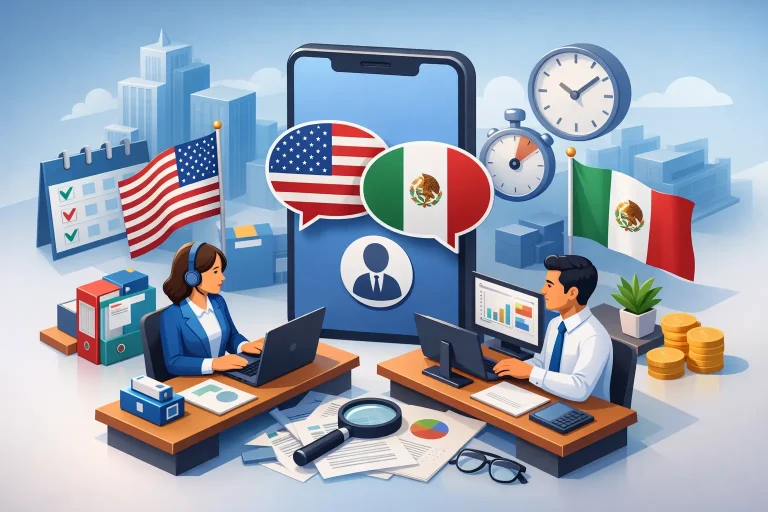
Loan volume rarely arrives at a convenient time. A rate change, referral surge, or strong purchase season can expose the same constraint fast: experienced processors, post-closing staff, and borrower support teams are difficult and expensive to hire domestically. Mortgage staffing Mexico gives lenders and mortgage businesses a practical way to add capable capacity without giving up control over the borrower experience or loan quality.
For US mortgage leaders, the value is not simply lower labor costs. The stronger case is operational: bilingual professionals working during US business hours, dedicated to your workflows, with the oversight needed in a compliance-heavy environment. When structured correctly, nearshore staffing helps teams protect turn times, reduce bottlenecks, and scale support around actual production needs.
Why mortgage staffing Mexico fits modern lending teams
Mortgage operations depend on handoffs. A file moves between loan officers, borrowers, processors, underwriters, title partners, closing teams, and post-closing staff. When any one function falls behind, the delay can affect borrower confidence, lock expirations, and funded volume.
Mexico, particularly Guadalajara, offers a compelling nearshore option because teams work in overlapping US time zones and can communicate with US-based colleagues in real time. That matters when a processor needs a condition clarified, a borrower needs a document request explained, or a post-closing exception must be addressed before the day ends.
The model also offers more flexibility than adding permanent domestic headcount for every volume spike. Rather than overloading core employees or making rushed hires, mortgage businesses can build a dedicated support team around repeatable work. The goal is not to replace strategic leadership, licensed decision-making, or functions that must remain internal. It is to place the right work with the right team so domestic staff can focus on revenue, judgment, escalation, and relationships.
Roles that create immediate capacity
The best nearshore mortgage roles are structured, process-driven, and measurable. They should have clear workflows, defined quality standards, documented systems access, and a US-based owner who can resolve exceptions.
Common mortgage staffing roles include:
- Loan processor assistants who gather documents, update loan origination systems, track conditions, and follow up on outstanding items
- Loan officer assistants who manage borrower communication, appointment coordination, prequalification support, and pipeline updates
- Transaction coordinators who organize milestones, documentation, and communication across parties
- Post-closing specialists who audit files, manage trailing documents, prepare packages, and track exceptions
- Quality control and compliance support staff who handle checklists, file reviews, document organization, and reporting under established procedures
- Customer service representatives who provide bilingual borrower updates and route complex questions to the appropriate licensed or senior team member
Not every activity should be moved at once. The most effective approach often starts with one high-friction workflow, such as conditions management or trailing-document follow-up. Once the team meets service-level expectations, leaders can add adjacent responsibilities.
Mortgage staffing Mexico requires a control-first setup
Nearshore staffing is not a shortcut around compliance. Mortgage companies still need to establish sound access controls, training, supervision, and documented procedures. The location of a team member does not reduce the need for disciplined operations.
Start by separating tasks that involve routine support from tasks that require licensing, credit decisions, underwriting authority, or direct legal interpretation. The exact line depends on your business model, state requirements, investor rules, and internal policies. A staffing partner can help source talent, but your organization must define role boundaries and approval paths.
Access should follow the principle of least privilege. Team members need only the systems, files, and permissions required for their role. Use company-managed accounts, multi-factor authentication, role-based permissions, secure devices, and auditable workflows. For teams handling nonpublic personal information, the physical environment matters too. Secure offices, restricted access, clear-screen policies, and monitoring standards should be part of the operating model, not an afterthought.
Training should mirror the seriousness of the work. That includes your loan process, escalation rules, borrower communication standards, document handling expectations, and quality-review procedures. A nearshore team performs best when it is treated as an extension of the operation, not as an outside queue receiving scattered requests.
How to measure whether the model is working
Cost savings matter, but cost alone is a poor operating metric. A lower-cost team that creates rework, borrower confusion, or compliance exposure is not a savings strategy. Performance should be measured against the outcomes that affect your loan pipeline.
For processing support, look at turn times for document collection, conditions follow-up, file updates, and aging items. For borrower-facing support, monitor response times, contact rates, satisfaction feedback, and escalation quality. In post-closing, track trailing-document aging, exception rates, file completeness, and rework volume.
Quality assurance should be built into the first 30 to 60 days. Review completed work regularly, identify repeat errors, and update job aids before small inconsistencies become habits. Weekly operating reviews are especially useful early on because they give leaders visibility into workload, quality, staffing needs, and unresolved process issues.
A dedicated team structure is usually stronger than an on-demand arrangement for mortgage work. Dedicated staff learn your systems, terminology, overlays, and communication style. That familiarity produces better judgment about when to proceed, when to escalate, and how to keep work moving without creating risk.
When nearshore mortgage staffing is not the right first move
Mortgage staffing Mexico is not a universal answer. If a company has undocumented workflows, inconsistent management expectations, or no one available to train and supervise new staff, adding people will not fix the underlying problem. It may simply increase the number of handoffs.
It can also be a poor fit for work that depends entirely on deep local market relationships or responsibilities that cannot be delegated under applicable rules. In those cases, the better first step may be process documentation, a domestic hire for a critical leadership gap, or technology improvements that remove manual work.
The key question is whether a role has repeatable tasks, clear outputs, and a defined escalation path. If the answer is yes, it is a strong candidate for nearshore support. If every assignment is unique and requires constant senior judgment, the role may need to stay closer to internal leadership until the process matures.
Building a team that scales with volume
The fastest deployments usually begin with a clear capacity plan. Identify the work backlog, the production goal, the systems involved, the expected daily volume, and the service level each role must meet. Then create a simple responsibility map: what the nearshore team owns, what it prepares, what it may communicate, and what must be escalated to a US-based employee.
Hiring for mortgage support should prioritize more than general administrative experience. Look for candidates with strong written communication, attention to detail, comfort with structured workflows, and the ability to work confidently in English and Spanish when borrower communication calls for it. Experience with loan origination systems, document management, CRM tools, or financial-services operations can shorten ramp time, but a disciplined training program remains essential.
GDL Connect helps US mortgage businesses build dedicated Guadalajara teams across processing support, transaction coordination, post-closing, compliance support, and customer-facing operations. The focus is to give leaders a lower-cost staffing model with the visibility, security, and real-time collaboration required to run a dependable lending operation.
The right first hire is rarely the most senior or the most complex role. It is the role that removes a persistent bottleneck, has measurable outputs, and gives your internal team more time to move loans forward. Start there, prove the workflow, and let performance determine the next layer of capacity.