

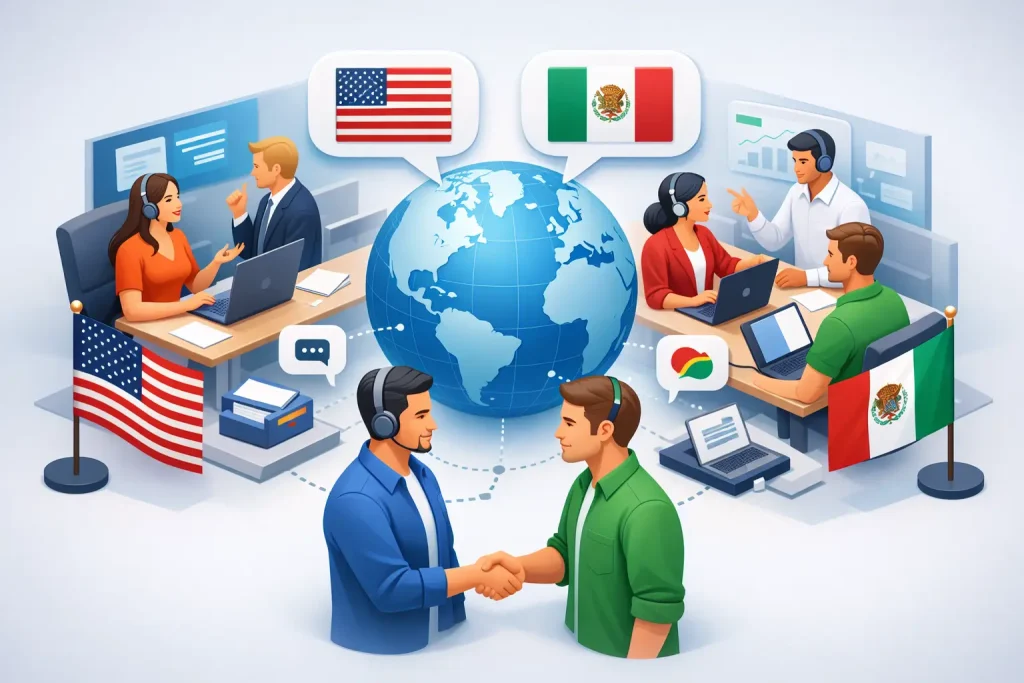
A lot of operational bottlenecks look like staffing problems at first. Then you get closer and realize the real issue is communication across teams, customers, vendors, and systems. If you need to build bilingual operations team capacity, you are usually solving for more than language. You are solving for speed, accuracy, coverage, and control.
That matters most when work moves between English and Spanish throughout the day. Mortgage files, patient coordination, claims support, sales follow-up, post-closing tasks, transaction updates, and customer service all break down quickly when language gaps slow handoffs or create avoidable errors. A bilingual operations team can fix that, but only if it is built around business outcomes rather than resumes alone.
Why companies build bilingual operations team capacity
Most companies do not reach this decision because bilingual staffing sounds nice to have. They get there because domestic hiring is getting more expensive, role coverage is inconsistent, and key workflows are too dependent on a few overstretched employees.
A bilingual team helps on two levels. First, it expands talent access for roles that require day-to-day communication in English and Spanish. Second, it improves execution in functions where delays are costly. If your team handles customer conversations, document collection, internal coordination, or compliance-sensitive processes, every misunderstanding creates rework.
This is why the best use case is not just a call center model. Bilingual operations support is often most valuable in back-office and cross-functional roles where precision matters. Think loan processing support, insurance verification, account servicing, healthcare scheduling, collections support, CRM management, quality assurance, and reporting. These are operational jobs with language requirements, not language jobs with vague operational expectations.
Start with the workflow, not the org chart
The fastest way to overhire is to decide on titles before you define the work. If you want to build a bilingual operations team that actually improves performance, start by mapping where language and process intersect.
Look at the tasks that regularly touch external stakeholders, internal US teams, and systems of record. Then ask three practical questions. Where are delays happening? Where do errors create cost? Which responsibilities are pulling high-value employees away from more strategic work?
That exercise usually reveals a clearer staffing plan than a generic headcount request. In some companies, the first hire should be a bilingual operations coordinator who manages intake, follow-up, and internal handoffs. In others, it may be a team of specialists handling documentation, customer communication, and quality control in parallel.
This is also where many leaders realize they do not need one generalist. They need role clarity. A strong bilingual team often performs better when responsibilities are split between process-heavy execution and customer-facing communication, even if both roles require the same language capabilities.
The roles that make the biggest difference first
There is no perfect blueprint, but a few roles consistently create early operational lift.
Bilingual coordinators are often the foundation. They keep workflows moving, track status, manage inboxes, schedule follow-ups, and make sure work does not stall between teams. In businesses with high transaction volume, this role pays for itself quickly because it reduces drag across the entire operation.
Bilingual customer support or service specialists are the next logical layer when customer experience is affected by wait times, inconsistent follow-up, or missed context. Their value is not just answering questions. It is protecting retention and reducing the volume of escalations hitting your core team.
Then come process specialists. Depending on the industry, that might mean mortgage support staff, claims support, post-closing specialists, patient support teams, accounting assistants, compliance coordinators, or sales support professionals. These roles work best when they are tied to clearly documented workflows and measurable outputs.
Management should come later than many companies expect. If your first few hires are strong and your process is well defined, you may not need a dedicated team lead immediately. Add management when coordination complexity justifies it, not because the org chart feels incomplete.
Hiring for bilingual ability is not enough
Fluency matters, but it is not the only filter. A candidate can speak both languages well and still struggle in an operations role if they lack process discipline, attention to detail, or confidence working inside structured systems.
That is why screening should reflect the actual job. If the role handles documentation, test written communication and accuracy. If it supports customers, evaluate tone, listening, and issue resolution. If it works across departments, test prioritization and handoff management.
You also need to define what bilingual means for the role. Some positions require native-level verbal fluency in both languages. Others need strong written English and conversational Spanish. Overstating the language requirement narrows your hiring pool. Understating it creates quality problems later.
The same goes for industry exposure. In regulated sectors like healthcare, finance, insurance, and mortgage, domain familiarity can matter as much as language ability. Training can close some gaps, but not all of them at speed.
Why nearshoring changes the operating model
If your goal is lower cost without losing responsiveness, nearshoring is often a better fit than traditional offshore staffing. Time zone alignment matters more than many companies assume. When teams can work within US business hours, communication becomes simpler, approvals move faster, and managers spend less time waiting for updates.
That advantage is especially clear in operations environments with daily dependencies. If a customer issue, underwriting condition, scheduling conflict, or compliance question needs same-day action, overlapping work hours are operationally meaningful. They are not just a convenience.
Guadalajara has become a strong market for this model because it offers bilingual talent, scale, and business infrastructure that supports professional operations work. For US companies trying to grow without absorbing full domestic payroll costs, that combination is attractive. It allows leadership to expand capacity while keeping visibility and execution standards intact.
Build oversight into the team from day one
A bilingual operations team should increase control, not reduce it. That only happens when reporting lines, service expectations, and performance metrics are clear early.
Start with documented processes and role ownership. Every recurring task should have a defined workflow, expected turnaround time, escalation path, and quality standard. If a task feels too informal to document, it is probably too informal to scale.
Then measure what actually reflects value. Output volume matters, but it is not enough. Track turnaround times, error rates, customer satisfaction where relevant, aging queues, and completion rates by function. A bilingual team should not become a black box. Leadership should be able to see exactly where performance is improving and where support is needed.
This is also where staffing partners can make a meaningful difference. The right partner does more than source candidates. They help structure roles, support ramp-up, and create operating conditions that let the team perform consistently. That is especially useful when companies want faster deployment without building every hiring and compliance layer internally.
Common mistakes when companies build bilingual operations team structures
The first mistake is using bilingual hires as a patch for broken processes. Language support can improve execution, but it cannot fix unclear ownership or inconsistent workflows.
The second is hiring too broadly. When every role includes customer service, admin work, reporting, and specialist tasks, accountability disappears. Clear scope almost always beats a catch-all job description.
The third is underinvesting in onboarding. Even experienced hires need context on systems, service standards, compliance requirements, and communication preferences. A slow ramp usually reflects a weak onboarding plan, not weak talent.
The fourth is assuming low cost should mean low structure. If anything, distributed operations require stronger management discipline. Expectations need to be explicit. Feedback loops need to be regular. Success should be measurable.
What a strong bilingual operations team looks like after 90 days
By the three-month mark, you should be seeing fewer stalled tasks, faster response times, and more consistency across high-volume workflows. Your domestic team should be spending less time on repetitive coordination and more time on exception handling, strategic decisions, and revenue-driving work.
You should also have better visibility. Not perfect visibility, but better. A strong team gives leadership cleaner reporting, clearer ownership, and more confidence that work is moving without constant intervention.
That is the real standard. Not whether the team is busy, but whether the business is operating with more speed and less friction.
For companies that need to scale support functions without sacrificing quality, the right move is rarely just hiring faster. It is building a team model that matches the work, supports collaboration, and gives you room to grow with control. If you approach it that way, bilingual operations staffing stops being a workaround and starts becoming an operational advantage.