

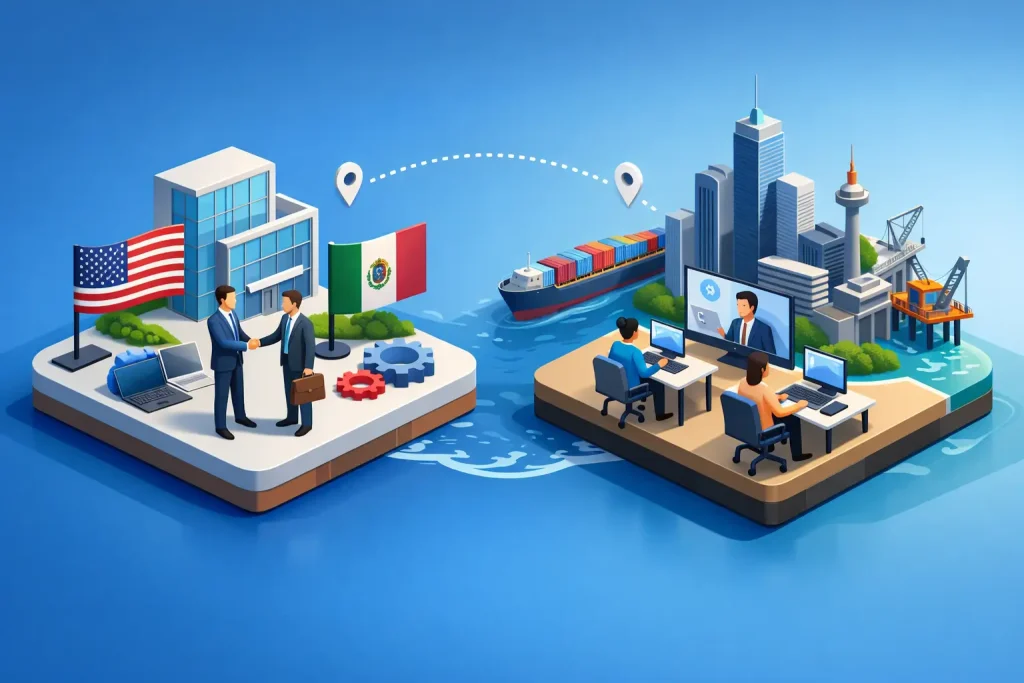
If your team is missing deadlines because hiring cannot keep up with demand, the nearshore vs offshore outsourcing decision stops being theoretical. It becomes an operating model question: where can you add capacity fast, lower labor costs, and still keep quality, responsiveness, and oversight where they need to be?
For most US companies, the answer is not simply whichever option is cheaper on paper. The better choice depends on what kind of work you need done, how closely that work touches customers or compliance, and how much real-time collaboration your managers need from the team.
Nearshore vs offshore outsourcing: what changes in practice?
Nearshore outsourcing means building teams in countries close to the US, often in similar time zones. Offshore outsourcing usually refers to hiring in more distant markets where labor costs may be lower, but the geographic, cultural, and time-zone gap is wider.
That distinction sounds simple, but its business impact is significant. If your outsourced function requires daily feedback, quick approvals, customer interaction, or close process control, proximity matters. If the work is highly structured, asynchronous, and less dependent on same-day collaboration, offshore can be effective.
This is why decision-makers often get stuck. Nearshore may cost more than the lowest offshore option, but it can reduce management friction. Offshore may offer stronger headline savings, but those savings can shrink when delays, rework, communication gaps, and turnover start affecting output.
Cost is only one line item
Executives usually begin with labor arbitrage, and that makes sense. Outsourcing is often triggered by rising payroll costs, long US hiring cycles, and margin pressure. Offshore markets can look attractive because base salaries are often lower than nearshore alternatives.
But direct compensation is not the whole model. You also need to account for onboarding time, management overhead, missed handoffs, process documentation, QA effort, and the cost of slower decisions. A lower hourly rate does not always produce a lower operating cost.
Nearshore teams often create savings in a different way. They may not be the absolute cheapest labor option, but they can accelerate output and reduce friction across the workday. When your internal team can communicate in real time, escalate issues quickly, and maintain tighter control, the total value often improves.
That matters even more in functions like customer support, accounting, sales support, healthcare operations, mortgage processing, transaction coordination, and software development. In these environments, speed and accuracy directly affect revenue, compliance, and customer experience.
Time zone overlap changes team performance
This is one of the clearest differences in nearshore vs offshore outsourcing, and it is often underestimated during vendor selection.
A team working while your managers sleep can be useful for certain workflows. If you have stable SOPs and clearly segmented tasks, offshore coverage may support overnight productivity. Some companies use that model well for backlogged, repetitive, or highly documented processes.
But many growth-stage and mid-market businesses do not operate with that level of process maturity. Their workflows change weekly. Priorities move fast. Managers need answers now, not tomorrow morning. In those cases, time zone overlap is not a convenience. It is a performance advantage.
Nearshore teams can join live meetings, respond to same-day changes, and collaborate with US departments without building a delay into every interaction. That tends to improve ramp speed, issue resolution, and accountability.
Communication quality affects output
Most outsourcing problems are not caused by a lack of effort. They come from misalignment.
When teams are far removed from the business, communication becomes more transactional. Instructions are handed off. Questions wait in queues. Context gets lost. Managers compensate by over-documenting or rechecking work, which defeats part of the efficiency gain they were trying to create.
Nearshore models often make communication easier because language alignment, cultural familiarity, and business-hour overlap support faster clarification. That is especially valuable in bilingual, customer-facing, and exception-heavy roles where nuance matters.
For example, if you are hiring support for sales operations, compliance review, claims processing, post-closing, or client service, small misunderstandings can create outsized downstream costs. The closer the outsourced team is to your daily operating rhythm, the easier it is to protect quality.
Control and compliance are not secondary concerns
Leaders in healthcare, finance, real estate, insurance, and regulated service sectors usually care about more than staffing volume. They need process discipline, secure handling of data, and confidence that the team can follow US-facing standards.
This is where the cheapest outsourcing option can become expensive fast. If workflows involve sensitive records, regulated documentation, or audit-sensitive tasks, management cannot afford loose oversight. They need visibility into who is doing the work, how it is being done, and what controls are in place.
Nearshore outsourcing tends to appeal to these buyers because it supports more direct management and easier operational alignment. Geographic proximity also makes site visits, training, and leadership interaction more practical. That does not automatically make every nearshore provider better at compliance, but it often makes strong governance easier to maintain.
Talent depth depends on the role
One mistake buyers make is treating outsourcing destinations like they are interchangeable labor pools. They are not.
Some offshore markets are excellent for large-scale, process-driven support. Others are well known for specific technical skills. Nearshore hubs can be particularly strong when companies need a mix of professional talent, bilingual capability, and close collaboration with US teams.
The role itself should guide the model. If you are hiring software engineers, finance support staff, AI engineers, operations specialists, or customer-facing professionals, the best answer depends on how much judgment, collaboration, and business context the role requires.
Guadalajara, for example, has become a strong nearshore talent market for companies that want technical and operational capability without losing day-to-day control. For businesses that need teams to move quickly and work in sync with US stakeholders, that kind of market can offer a more practical balance of cost and performance than a far-off offshore model.
When offshore outsourcing makes sense
Offshore is not the wrong choice. It can be a smart one.
If your company has mature systems, stable documentation, and work that can be completed asynchronously, offshore outsourcing may deliver meaningful savings. It can also help organizations that need around-the-clock coverage or high-volume execution in clearly defined processes.
The key is management readiness. Offshore works best when tasks are standardized, quality metrics are explicit, and your internal team knows how to run distributed operations without constant live interaction. If that foundation is weak, offshore often exposes process gaps rather than solving them.
When nearshore is the better business move
Nearshore tends to win when speed, visibility, and collaboration matter as much as labor cost.
That is often the case for US companies that are scaling quickly, struggling to hire domestically, or trying to protect service quality while expanding capacity. It is also a strong fit for departments where delays hurt revenue or customer trust, such as sales support, account management, operations, engineering, and regulated back-office work.
This is the appeal of partners like GDL Connect. The value is not just lower-cost staffing. It is the ability to build dedicated teams that work in sync with US operations, ramp fast, and support tighter operational control.
How to choose the right model for your business
Start with the work, not the map. Ask how often your outsourced team will need live guidance, how much customer or compliance exposure they will have, and whether your managers have the bandwidth to run an asynchronous operation.
Then pressure-test the economics. Compare not only salary and vendor pricing, but also the cost of delays, training, QA, communication friction, and management time. The right model is the one that improves output without creating hidden drag inside the business.
Finally, think about where your company is headed. If you need a flexible team that can scale with you, adapt to changing priorities, and integrate tightly with US stakeholders, nearshore may produce stronger long-term returns even if the hourly rate is higher. If your work is stable and your operating processes are already disciplined, offshore may be the more efficient fit.
The best outsourcing strategy is rarely about chasing the lowest number. It is about building a team structure that supports growth without adding complexity you will later have to undo.